Are DIY Leak Detection Tools Reliable?
Are DIY Leak Detection Tools Reliable?
DIY leak detection tools can be useful, but their reliability depends on the question you are asking. They can often help you answer, "Do I probably have a leak?" They are much less reliable for answering, "Exactly where is the hidden leak, and what should be opened for repair?"
That difference matters. A homeowner meter test, moisture alarm, or basic thermal camera can point you toward a problem. A hidden leak behind a wall, under a slab, below tile, or inside a drain assembly usually requires professional testing before repair decisions are made.
What DIY Methods Can Do

Simple DIY checks can be effective for visible or easy-to-confirm leaks:
- Water meter test: Turn off all fixtures and see whether the meter still moves.
- Toilet dye test: Put dye in the tank and watch for color entering the bowl without flushing.
- Visual inspection: Check under sinks, around toilets, behind appliances, near water heaters, and around shutoff valves.
- Moisture alarms: Place sensors near appliances, water heaters, or under cabinets to alert you to water.
- Bill comparison: Look for unexplained increases in water use.
These steps are helpful because they create a starting point. They may confirm a leak exists, identify an obvious fixture leak, or show that a problem is active enough to investigate.
Where DIY Tools Become Less Reliable
DIY tools usually struggle when the leak is hidden, intermittent, or affected by other building conditions. Common limits include:
- A meter test can show water is moving, but not where it is going.
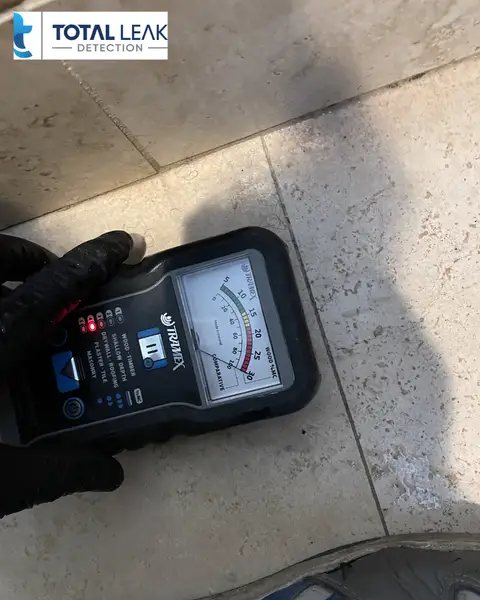
- A basic moisture meter can show dampness, but not the original source.
- A consumer thermal camera can show a hot or cool pattern, but not whether it is plumbing, HVAC, sunlight, or exterior water.
- Listening by ear may miss small pressurized leaks or confuse plumbing noise with appliance or air movement.
- A stain may appear far from the actual leak because water travels through framing, insulation, cabinets, or slab gaps.
That is why DIY checks are best treated as screening tools, not final diagnosis.
Comparing DIY Tools With Professional Leak Detection
Professional leak detection adds calibrated tools and testing methods that are difficult to duplicate at home:
- Acoustic listening equipment for pressurized supply leaks.
- Correlators that compare leak sounds between two pipe access points.
- Thermal imaging interpreted alongside moisture readings.
- Pressure testing to isolate which system is losing pressure.
- Fixture testing to reproduce shower, tub, toilet, drain, or appliance leaks.
- Line tracing to understand where pipes run before access is made.
For a slab leak, the value is not just the equipment. It is knowing how to combine the meter behavior, pipe layout, acoustic signal, thermal pattern, and moisture readings into one repair recommendation.
When DIY Is Enough
DIY may be enough when the leak is visible, accessible, and clearly connected to a fixture. Examples include:
- A dripping supply valve under a sink.
- A toilet flapper leaking into the bowl.
- A loose washing machine hose connection.
- Condensation or water around an appliance with an obvious source.
- A water heater connection that is visibly dripping.
In those cases, repair may be the next step. Detection becomes more valuable when the source is hidden or uncertain.
When to Stop DIY and Call a Professional
Stop the DIY process and schedule help if:
- The meter moves when all fixtures are off, but you cannot find water.
- You hear running water or hissing inside a wall or floor.
- Flooring is warm, damp, buckling, or separating.
- A stain dries and then returns.
- You smell musty odors near a bathroom, kitchen, laundry room, or exterior wall.
- Water is near electrical outlets, panels, or fixtures.
- You are about to cut drywall, tile, cabinets, or flooring just to look around.
Continuing to guess can create extra drywall, flooring, or cabinet repairs without solving the leak. A professional inspection is often less expensive than one unnecessary opening in the wrong place.
How to Make DIY Checks More Useful
Before your appointment, keep a simple record:
- Photograph stains, damp areas, meter readings, and visible leaks.
- Write down when the symptom appears: after showers, laundry, rain, irrigation, dishwasher use, or hot-water use.
- Note whether the water meter moves with everything off.
- Avoid running fans or dehumidifiers in a way that hides active symptoms before photos are taken.
- Do not remove damaged materials unless water is actively spreading or safety requires it.
These details help the technician choose the right test and can also support insurance or repair documentation if the leak turns out to be significant.
Summary
DIY leak detection tools are reliable for simple checks and visible leaks, but they are not reliable enough to pinpoint most hidden leaks. Use them to confirm whether a problem likely exists. If the source is behind a wall, under a slab, intermittent, or unclear, schedule professional leak detection before opening finished surfaces.
Frequently Asked Questions
- Are DIY leak detection tools reliable?
- DIY tools and checks are reliable for simple confirmation, such as seeing a water meter move when all fixtures are off or finding moisture under a sink. They are not reliable for pinpointing most hidden leaks behind walls, under slabs, below flooring, or in buried lines.
- What DIY leak checks should I try first?
- Check visible fixtures, look for toilet tank leaks, inspect under sinks and appliances, compare water bills, and watch the meter with all water off. Stop if you cannot identify the source or if water is near electrical components.
- When should I call a professional instead of using DIY tools?
- Call a professional when the meter moves but you cannot see a leak, stains or odors return, flooring is warm or damp, multiple areas are affected, or you are considering opening walls or floors.