Can Leak Detection Find Leaks Without Cutting Walls?
Can Leak Detection Find Leaks Without Cutting Walls?
In many cases, yes: professional leak detection can locate or narrow a hidden leak before anyone cuts into a wall. The goal is not to pretend repairs never require access. The goal is to replace guesswork with evidence so any opening is small, targeted, and made in the right place.
That matters when the visible symptom is vague: bubbling paint, a ceiling stain, a damp baseboard, musty odor, or the sound of running water with no fixture on. Without detection, the repair often starts with "open this wall and see." With detection, the technician tests the likely systems first.
What "Without Cutting Walls" Really Means

Leak detection is usually non-invasive during the diagnostic phase. Technicians may scan, listen, test pressure, run fixtures, and map moisture without opening finished surfaces. If the leak is inside a wall cavity, the actual plumbing repair may still require a cutout. The difference is that the cutout is made where the evidence points, not across multiple walls in search of the source.
That can reduce:
- Extra drywall removal and repainting.
- Flooring or cabinet damage from exploratory access.
- Delays while the wrong area is opened first.
- Confusion between plumbing, roof, window, HVAC, and appliance sources.
Tools Used Before Any Wall Is Opened
Technicians choose tools based on the suspected system:
- Acoustic listening: detects the sound of water escaping from pressurized pipes.
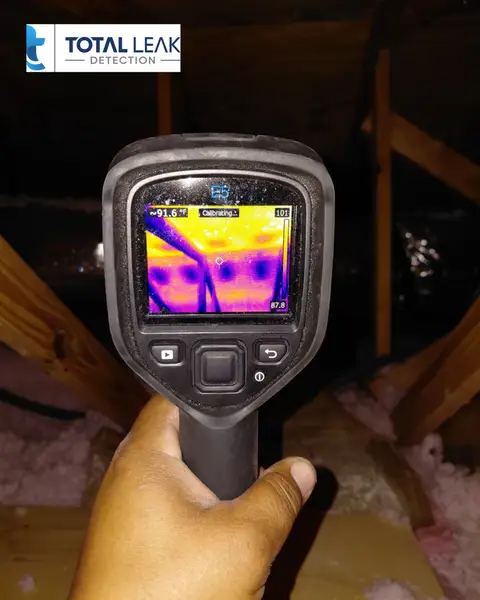
- Thermal imaging: shows temperature differences from hot water, cooling moisture, or wet materials.
- Moisture mapping: identifies where water has traveled inside walls, ceilings, flooring, or cabinets.
- Pressure testing: helps confirm whether a supply line, drain line, or fixture assembly is losing pressure.
- Fixture testing: runs showers, tubs, sinks, toilets, or appliances one at a time to reproduce the leak.
- Line tracing: maps pipe paths so a leak location makes sense relative to the plumbing layout.
For a slab leak, the technician may combine acoustic equipment, thermal imaging, pressure testing, and pipe tracing. For a wall or ceiling stain, fixture testing and moisture mapping may be more useful.
What Happens After the Leak Is Located
Once the technician has narrowed the source, you should receive a clear explanation of the findings. Depending on the situation, that may include a wall or floor mark-out, photos, moisture readings, a written report, or a recommendation for where the plumber should make access.
The repair path depends on the source:
- A supply line leak may require a small drywall opening to access and replace the damaged section.
- A drain leak may require access near the trap, tub waste and overflow, shower, or vertical stack.
- A shower pan or waterproofing failure may require a different repair plan than a pipe leak.
- A pipe burst may need faster access if water is actively spreading.
Good detection does not eliminate every repair opening. It helps make the first opening the right one.
When Non-Invasive Testing Is Most Valuable
Non-invasive testing is especially helpful when:
- The wet area is far from the actual plumbing source.
- More than one bathroom, fixture, or wall could be responsible.
- The leak is under tile, behind cabinets, above a finished ceiling, or below a slab.
- You need documentation for insurance or a contractor.
- You want to avoid opening expensive finishes until the likely source is known.
When a Small Access Opening May Still Be Needed
Some leaks cannot be fully confirmed from the finished side. Very slow leaks, intermittent drain leaks, exterior wall intrusion, and complex plumbing chases may require limited access after testing narrows the area. That is still different from blind demolition because the opening is based on test results.
If a company promises to find every leak without any possibility of access, be cautious. A better promise is careful testing, clear findings, and targeted repair guidance.
Bottom Line
Leak detection can often find or narrow hidden leaks without cutting walls during diagnosis. Repairs may still require a small opening, but the point is to avoid cutting blindly. If you hear water, see staining, smell musty odors, or have unexplained moisture, schedule detection before opening walls or floors.
Frequently Asked Questions
- Can leak detection find leaks without cutting walls?
- Often, yes. Professional leak detection uses acoustic listening, moisture mapping, thermal imaging, pressure testing, line tracing, and other methods to narrow the leak location before walls are opened. Repairs may still require a small targeted access point, but detection helps avoid blind demolition.
- Does leak detection repair the leak without opening the wall?
- Leak detection usually identifies the source and location; the repair still depends on the pipe, fixture, drain, or waterproofing detail involved. The advantage is that the repair opening can often be smaller and more targeted.
- What leaks are hardest to find without opening walls?
- Very slow intermittent leaks, drain leaks that only appear during use, and moisture from roofs, windows, or exterior walls can require more testing and sometimes limited access to confirm the source.