Initial Mold Assessment vs Post-Remediation Clearance After a Leak
Initial Mold Assessment vs Post-Remediation Clearance After a Leak

If you are comparing an initial mold assessment vs post-remediation clearance after a leak, you are already asking a more useful question than many homeowners ask at first.
Total Leak Detection already has broader timing explainers for readers who are still deciding whether mold testing makes sense at all after water damage, including How Soon After Water Damage Should You Test for Mold?, Do I Need a Mold Test After Water Damage?, and the existing small-leak explainer on whether testing is necessary after a minor water event. This article handles the narrower follow-up job those pages do not own as directly:
Do I need a report that documents the current condition, or do I need a later clearance test that confirms cleanup passed?
Those are different deliverables, used at different stages, for different decisions.
Sometimes an earlier assessment makes sense because there is visible growth, a strong odor, or a report is needed for a carrier, buyer, landlord, or contractor. Other times, the smarter first move is to stop the water source, dry the affected materials quickly, and then decide what documentation still adds value. And when remediation has already happened, the right service may be post-remediation clearance, not another front-end assessment.
That is why timing still matters inside this narrower comparison. Total Leak Detection's mold-testing service page explains that water-damage events can lead to mold growth quickly, while EPA guidance says water-damaged materials should be dried within 24 to 48 hours to help prevent growth. Those two facts point to the same reality: you still need a sequence, but the sequence should point you toward the right report for the stage you are actually in.
Here is the short version:
| Stage of the problem | Best question to ask first | Most useful next move |
|---|---|---|
| The leak just happened and the area is still wet | Do we need a current-condition report before the scene changes? | Stop the water, document the scene, and decide whether an initial assessment adds value now |
| Moisture is under control, but the scope is still unclear | Are we still documenting the present condition, or has the question shifted to cleanup confirmation? | Dry aggressively and match the testing scope to what remains unresolved |
| Remediation is complete and you need proof the area passed | Are we talking about another assessment or actual clearance? | Schedule post-remediation clearance if a final pass/fail record is needed |
This guide is built around that distinction so you can pick the right service for the right stage instead of paying for the wrong report first.
Why this is not the same question as “Should I test after water damage?”
The phrase "after a leak" hides two different conversations that often get blurred together.
The first conversation is broad: Do I need mold testing at all after water damage? TLD already addresses that intent directly in the three live timing posts linked above.
The second conversation is narrower: If testing or reporting is already on the table, do I need an initial assessment now or a post-remediation clearance later?
That is a different reader job, and it usually shows up when one of these things is true:
- a carrier, buyer, landlord, or contractor needs a report,
- remediation may already be planned or underway,
- the water source may be solved, but someone still needs a record of the present condition,
- or the homeowner needs to know whether the next paid step should document the problem or confirm the cleanup result.
EPA's A Brief Guide to Mold, Moisture and Your Home says the key to mold control is moisture control and that water-damaged materials should be dried within 24 to 48 hours to help prevent mold growth. That guidance does not choose the report for you. It does tell you that the environment is changing while you are deciding what documentation even makes sense.
That is why the narrower comparison matters. You may need:
- An initial assessment to document what is happening now.
- Aggressive drying and source control because the scene is still changing.
- A later clearance test to confirm that remediation passed after cleanup is complete.
When homeowners get frustrated, it is usually because those three jobs were collapsed into one vague request for “a mold test.”
When an initial mold assessment is the right deliverable
An initial assessment becomes the better fit when the current condition itself still matters.
That usually means one or more of these conditions are true:
- there is already visible growth or a persistent musty odor,
- the leak source may be controlled, but the extent of the affected area is unclear,
- you need a current-condition report for insurance, a buyer or landlord conversation, or a contractor handoff,
- the moisture problem may be affecting multiple rooms, HVAC pathways, or concealed cavities,
- or different trades are already disagreeing about what the real problem is.
According to TLD's mold-testing requirements for insurance claims in Florida article, some carriers may ask for mold testing or post-remediation clearance as part of a water-damage claim, and the exact requirement varies by carrier and policy. That does not mean everyone needs testing for every leak. It means documentation needs can push the timing earlier.
An initial assessment can also help when you need a clearer snapshot of the present condition before repairs change the scene. TLD's mold-testing guide describes initial testing as something that can include air and surface sampling, lab analysis, and a written findings report. That kind of work is most useful when the question is still “What is going on here right now?”
What an initial assessment does well:
- helps describe the present condition,
- helps define whether the concern looks isolated or broader,
- helps create a report others can review,
- and helps separate "possible mold concern" from "documented current findings."
What an initial assessment does not do:
- it does not replace moisture control,
- it does not by itself prove the water source is solved,
- and it does not serve as final clearance after remediation.
That last point is where many handoffs go wrong. Homeowners sometimes schedule an early assessment hoping it will also count as the final cleanup confirmation later. Usually it will not. It can be the right first step, but it is still a first-step service.
Why drying still matters before either step
The other common mistake is delaying drying because everyone is still arguing about which report they need.
EPA says to fix the water problem, dry the affected area, and dry items completely. On its Mold Cleanup in Your Home page, EPA also notes that porous materials may need to be discarded if they become moldy. In other words, there is a practical reason to move quickly even while you are still deciding whether the next paid step should be assessment or clearance.
Drying first tends to make more sense when:
- the leak is recent and there is no clear visible growth yet,
- the affected area is limited and the moisture source is already obvious,
- the main question is whether the wet materials can be dried successfully before the situation grows,
- or the first priority is preventing the scene from getting worse while you preserve evidence with photos, video, notes, and receipts.

Drying first does not mean ignoring the documentation side. It means the immediate work is moisture control while the documentation strategy happens in parallel. If the room is actively wet, drywall is saturated, or materials are still changing hour by hour, the most useful action may be to stabilize the environment first so the follow-up assessment is looking at a more honest condition.
This is especially true when homeowners are tempted to order an initial assessment simply because they feel they should “do something.” A useful question is:
Will this report answer the problem I have right now, or do I first need to stop the moisture from changing the problem every hour?
If you are not sure, a professional intake conversation can help separate urgent drying decisions from later assessment or later clearance decisions. That is more valuable than assuming every leak follows the same script.
What post-remediation clearance actually confirms
One of the biggest reader frustrations around this topic is not knowing what changes once remediation is complete.
That is where post-remediation clearance becomes its own deliverable rather than a synonym for more mold testing.
TLD's mold-testing guide and insurance article both point to the same distinction: initial testing describes the current condition, while post-remediation clearance is a later-stage confirmation after cleanup work is finished. Clearance belongs at the back end of the process, not at the front.

This is the clearest way to think about it:
| Service | Core question it answers | Best time to use it |
|---|---|---|
| Initial mold assessment | What is the current condition, and what should we do next? | After the leak is discovered, when present-condition findings still matter |
| Post-remediation clearance | Did the remediated area pass after cleanup and drying? | After the remediation work is complete |
Why this matters so much:
- Booking clearance too early can produce a failed or inconclusive result because the area is still changing.
- Booking only an initial assessment when the project really needs a final pass/fail record can leave the job feeling unfinished.
- Using the wrong service name with a carrier or contractor can create confusion about what deliverable you actually need.
If the work is already underway or the cleanup is nearly done, ask directly whether you are looking for a final clearance report rather than another initial assessment. That single wording change often saves time and avoids mismatched expectations.
What to ask before you book the visit
Most homeowners do not need a technical lecture before they schedule help. They need a short list of questions that keeps the intake call honest.
Start with these:
- What stage are we in right now? Fresh leak, ongoing drying, open demolition, or post-remediation?
- What will the report be used for? Insurance, contractor planning, owner peace of mind, or final clearance?
- Is visible growth present, or is this still a moisture-only concern?
- Do we need a current-condition report, or will a later clearance report be the more useful deliverable?
- Has the water source actually been corrected, or is that still uncertain?
When the answer is "we need documentation for the file," TLD's insurance article is a good reminder that the carrier may care about different things at different times. Some files need present-condition proof. Others care more about what happens after remediation. That is why the homeowner should ask what documentation is needed now, rather than assuming one report solves the whole claim.
When the answer is "we just want to know if mold is present," the better follow-up question is often:
What decision are we trying to make with that answer?
That decision could be:
- whether remediation scope needs to widen,
- whether drying is enough for now,
- whether demolition needs to pause,
- whether the file needs a report before conditions change,
- or whether the project has reached the point where clearance belongs next.
The tighter that question is, the better the testing scope usually becomes.
When leak detection belongs in the same conversation
An initial assessment or clearance report can describe mold conditions, but neither one always settles the most important operational question: why is moisture still there?
That is where source-finding can matter just as much as mold sampling.
If the room keeps getting damp, if different contractors keep blaming different systems, or if the leak pattern still is not fully explained, mold testing alone may leave an important gap. The mold result tells you what condition exists. It does not automatically confirm which plumbing, roof, appliance, shower, or hidden-line issue is feeding the condition.
In those cases, professional leak detection belongs in the same conversation because it answers a different question:
- mold testing helps define the environmental condition,
- leak detection helps define the moisture source that must be corrected,
- and together they help keep cleanup from becoming a repeating cycle.
This matters especially when:
- the wet area dries and then becomes damp again,
- the stain pattern keeps returning after cosmetic repairs,
- the source is still uncertain after a plumber or contractor visit,
- or the property needs a more complete documentation trail before major repairs are approved.
If the moisture source is still a guess, the timing decision on mold testing becomes harder because the underlying problem is still moving. Once the source question is clearer, the mold-testing scope often becomes clearer too.
The practical rule to remember
The best rule is not "always assess immediately" or "always wait."
It is this:
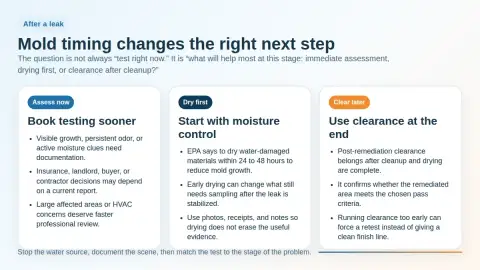
- Use an initial assessment when the current condition itself needs to be documented or understood.
- Dry first when active moisture control is the main priority and the environment is still changing quickly.
- Use clearance later when remediation is done and you need a final confirmation step.
If you are still sorting out whether mold testing is needed at all, start with TLD's broader timing explainers linked earlier. If you already know some form of testing or reporting belongs in the process, then this narrower comparison is the one that matters: are you documenting the current condition, or confirming the cleanup result?
If the moisture source itself is still unresolved, bring that into the conversation too. In many homes, the most useful next step is not just “a mold test.” It is a coordinated plan that matches the report to the stage of the leak.
This article is for general education only, not medical, legal, insurance, or remediation advice. Every property and claim timeline is different, so confirm the right testing, drying, and documentation sequence with qualified professionals before authorizing work.