Pool Leak Bucket Test: How to Tell Evaporation From a Real Leak
Pool Leak Bucket Test: How to Tell Evaporation From a Real Leak

If your pool level keeps dropping, the first question is usually not "Where is the crack?" It is "Am I actually looking at a leak, or am I misreading normal water loss?" A pool leak bucket test is the best homeowner-safe starting point because it gives you a cleaner answer than eyeballing the tile line every morning.
That matters in South Florida. Heat, wind, splash-out, afternoon storms, and automatic refill systems can all muddy the picture. Total Leak Detection's pool leak service page says warning signs include water loss greater than one-quarter inch per day, constantly adding water, cracks around the deck, wet or spongy areas near the pool, algae despite proper chemistry, and air bubbles in return jets. But even those clues need context. A busy summer weekend and a stuck autofill do not mean the same thing.
The goal of this article is practical: help you run the test correctly, read the result without fooling yourself, and know when the next step should be professional leak detection instead of more guesswork.
Why pool water loss gets misread in South Florida
Most homeowners notice the symptom before they understand the pattern. The waterline seems lower than usual. The autofill clicks on more often. The deck near one corner looks damp. Then the weather changes, kids swim all weekend, or a storm rolls through, and the clues stop matching each other.
That is exactly why pool water loss is easy to misread here. The U.S. Environmental Protection Agency's WaterSense pool guide says evaporation depends on temperature, humidity, wind, and water temperature, and that an uncovered 500-square-foot residential pool can lose roughly 12,000 to 31,000 gallons of water per year to evaporation alone. Heated pools can lose even more.
So yes, evaporation is real. But it is not the whole story.
The City of Scottsdale's homeowner pool guidance points out that an autofill can hide a leak by replacing water automatically before the owner ever sees a visible drop. That is one of the most important details people miss. If the pool is always being topped off, you are not measuring loss anymore. You are measuring how good the refill system is at hiding it.
Total Leak Detection's Miami pool page also frames the local challenge honestly: summer humidity, heavy rains, mixed property types, and different plumbing layouts can make casual walk-around observations less reliable than homeowners expect. In other words, South Florida weather can blur the difference between a normal bad week for evaporation and a real leak that deserves testing.
How to run a pool leak bucket test without false readings
The bucket test is simple, but most bad results come from skipping one of the setup steps.
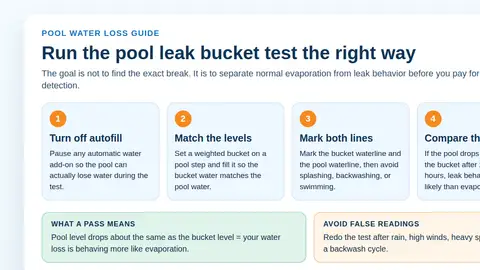
The City of Chandler pool care guide gives the cleanest version of the method:
- Turn off the autofill if your pool has one.
- Place a weighted bucket on a pool step.
- Fill the bucket so the bucket water matches the pool water level.
- Mark both waterlines.
- Wait through a calm test window before comparing the drops.
That sounds easy, but the discipline matters more than the bucket.
Use a test window when:
- rain is not expected,
- no one will be swimming,
- you will not backwash the filter,
- and no one will "help" by topping off the pool.
Scottsdale adds another important caution: do not let splash-out, backwashing, or frequent manual refills pollute the test. If the pool and the bucket both lose water under the same conditions, that is evaporation behavior. If the pool loses more, leak behavior becomes the stronger suspect.
The bucket test is not trying to impress anyone. It is trying to remove excuses from the data.
What the result means with the pump on, the pump off, or the autofill running
The first test only tells you whether the pool is behaving more like evaporation or more like a leak. The second round tells you where to look next.

Chandler and Scottsdale both recommend repeating the test under different operating conditions:
- once with the pump running normally,
- and once with the pump off.
That comparison is useful because different parts of the pool system behave differently depending on circulation.
If the pool loses more water when the pump is running
That points more toward the pressure side of the system: return plumbing, equipment connections, or another component that leaks more clearly under circulation pressure.
If the pool loses more water when the pump is off
That makes the shell, a fitting, or another non-pressure-only problem more suspicious. Sometimes homeowners also notice that the waterline seems to stop falling at roughly the same height each time. That can be a clue worth documenting for a specialist, especially around skimmers, fittings, or lights.
If the autofill is left on
You may not be testing anything useful at all. Scottsdale's guidance is blunt on this point: an autofill can mask a leak by replacing lost water automatically. A "perfectly stable" waterline does not prove the pool is healthy if a refill system is feeding it all day.
That is why the right question is not just "Did I lose water?" The better question is "Under which operating condition did I lose more water?"
Signs the leak is in the pool shell, plumbing, or equipment
Once the test says the pool is losing more water than normal evaporation would explain, the next job is to organize the clues.

Total Leak Detection says common pool-leak causes include shell deterioration, ground movement, plumbing connection failures, skimmer or return fitting leaks, main drain issues, light fixture seal failures, and equipment-pad plumbing leaks. That is a wide list, so the clues matter.
A few practical examples:
- Wet or spongy soil near the pool can point toward buried plumbing, the shell edge, or fittings.
- Air bubbles in return jets can suggest a plumbing-side issue.
- Visible drips or white mineral crust on pool pipes or equipment make the equipment pad worth close attention.
- Cracks around the pool deck or coping do not prove a leak by themselves, but they belong in the evidence file.
- Water that seems to stop at the same height can be more useful than a vague statement like "it keeps going down."
The trap is jumping straight from one clue to one cause. That is how homeowners start replacing the wrong valve, blaming only evaporation, or assuming the shell is cracked when the autofill or equipment is the real issue.

You do not need to diagnose the exact failure yourself. You only need to hand the next technician a cleaner starting point.
When water loss is more than normal evaporation
This is where readers usually want one magic number. Realistically, you need a threshold and a little judgment.
EPA WaterSense says a pool losing more than 2 inches of water per week is likely leaking, and in hotter, drier conditions the threshold may stretch closer to 3 inches per week before a leak becomes the stronger explanation. Total Leak Detection's own pool page uses a more urgent homeowner-facing warning sign: more than one-quarter inch per day.
Those two ideas are not actually fighting each other. They are answering different questions.
- EPA is helping you understand the broader water-use scale.
- TLD is helping you recognize when the symptom has become operationally suspicious.
You should also use common sense about what else is happening:
- Did wind or swimmer activity change dramatically?
- Is the pool heated?
- Was the pool recently backwashed?
- Was the autofill left on during part of the observation window?
- Did the water loss clearly change when the pump setting changed?
If the answer still looks abnormal after a clean bucket test, stop treating the drop as "probably just weather."
What to document before you call pool leak detection
The best service calls start with a short file, not a long theory.
Before you schedule professional help, gather:
- a photo of the bucket-test marks,
- the number of hours the test ran,
- whether the pump was on or off,
- whether the autofill was disabled,
- photos of damp soil, deck cracks, or the equipment pad,
- notes on air bubbles, algae, or unusual runtime,
- and whether the level seems to stop at a repeatable height.
That kind of record helps because professional pool leak detection is most valuable when it stays targeted. TLD says its pool-leak approach uses dye testing, pressure testing, and electronic detection to locate shell, plumbing, and equipment leaks more precisely. The more clearly you can describe the pattern, the easier it is to choose the right next test instead of throwing time at the wrong part of the system.
This is also where homeowners should stay disciplined about what the bucket test cannot do. It can tell you the pool is behaving like it has a leak. It cannot tell you, by itself, whether the final fix is a skimmer seal, a return line, a light niche, an autofill supply line, or an equipment-pad joint.
When to stop testing and schedule professional help
Do not turn this into a weekend hobby if the evidence is already strong enough.
It is time to move from homeowner testing to professional help when:
- the pool keeps losing more water than the bucket,
- the autofill seems to run constantly,
- the pump-on versus pump-off test points toward plumbing,
- the deck or surrounding soil feels wet or unstable,
- air bubbles keep showing up in the returns,
- or the loss is large enough that you are adding water constantly just to maintain operation.
TLD's pool leak page makes the stakes clear: pool leaks waste water and chemicals, can damage surrounding structures, and can undermine the pool's integrity. The company also says even a one-inch-per-day leak can add up to more than 10,000 gallons per month. At that point, waiting is usually more expensive than testing.
If you are already at the stage where the bucket test is positive, the clues are organized, and the pool still drops faster than evaporation would explain, the next move is not more guessing. It is a targeted pool leak detection visit or a direct request through TLD's contact page so the shell, plumbing, or equipment can be tested with the right tools.
The honest expectation is simple: the bucket test helps you decide whether the pool is acting like it has a leak. Professional detection tells you where the problem is most likely living and what kind of repair path makes sense next.
This article is for general information only and is not pool-repair, structural, or legal advice. Conditions vary by property, weather, and pool design, so confirm next steps with a qualified leak-detection or pool-repair professional before repairs begin.