Updated November 23, 2026.
Slab Leak Detection: Protect Your Foundation Before It's Too Late
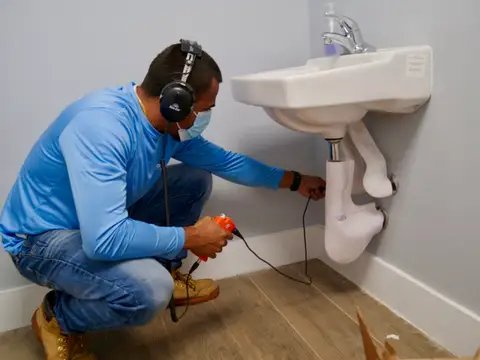
Slab leak detection finds where a water line under your concrete floor is leaking, and marks that spot before anyone breaks the concrete. We confirm the loss at the water meter, isolate the hot and cold lines and pressure test them, then listen with acoustic equipment and scan with a thermal camera until the leak narrows to one spot on the floor. You leave with the mark, and you get a written report with photos and the exact location, so your plumber opens the floor once.
Total Leak Detection is family-owned since 2019 and based in Doral. We locate slab leaks across Miami-Dade, Broward, and Palm Beach. A typical residential leak detection takes 1 to 3 hours on site, and the written report follows within 48 hours.
Book $49 Leak Evaluation - Insurance Accepted
Signs of a slab leak
You cannot see the pipe, so a slab leak shows up as indirect clues. Watch for:
- A warm spot on the floor, often on tile, when a hot-water line is leaking under it
- A water meter that keeps moving with every fixture and appliance off
- A water bill that jumped when your usage did not change
- The sound of running water when nothing is on
- Damp, cracked, or lifting flooring, or dampness at a baseboard with no fixture nearby
- A musty smell with no visible source
- Low water pressure across the house
Cracks on their own have many causes, including settling and temperature changes. Pair a crack with a meter check before you assume a slab leak.
Symptom triage: call now vs monitor
Use this to decide urgency—not as a substitute for professional detection.
| Symptom | Likely cause | Call now vs monitor |
|---|---|---|
| Floor warm in one spot; hot water only feels weak | Hot-water line under slab | Call now — active pressurized leak; damage spreads daily |
| Water meter spins with all fixtures off | Continuous pressurized supply leak | Call now — confirm with a 15-minute meter test, then book detection |
| Unexplained bill spike + no visible fixtures dripping | Hidden supply or slab leak | Call soon (same week) — rule out irrigation first, then detection |
| Soft/warped flooring or musty smell near exterior walls | Prolonged moisture under slab or wall cavity | Call now — mold and structural risk; stop DIY drying alone |
| Hairline wall/foundation cracks only, no water cues | Settlement or age (not always a leak) | Monitor 1–2 weeks; escalate if paired with meter/bill/warm-floor signs |
| Running-water sound with everything off | Active leak in slab or wall chase | Call now — do not wait for puddles |
| Low pressure house-wide, no warm floor | Municipal supply, softener, or whole-home restriction | Monitor briefly; call if meter still moves or pressure drops suddenly |
| Small outdoor wet patch near foundation after dry weather | Possible slab/perimeter line leak | Call soon — distinguish from irrigation overspray |
For what each sign means on its own, see our slab leak problem guide.
How we find a slab leak without breaking the floor
We use acoustic listening devices, thermal imaging, pressure testing, and electronic leak detection equipment. Each answers a different question, so we use them in order.
1. Meter check
With every fixture off, a moving meter confirms that water is leaving the system. It tells us there is a loss. It does not tell us where.
2. Isolation and pressure test
A slab can hold hot supply, cold supply, and drain lines. We close valves to split the system and pressure test each supply line, so we know whether the leak is on the hot side, the cold side, or both before anyone looks at the floor.
3. Acoustic listening
Water escaping a pressurized pipe makes noise. We listen through the floor along the line route and mark where the sound is strongest.
4. Thermal imaging
A thermal camera shows surface temperature patterns, not water. A warm patch over a hot-water line is evidence that tells us where to test more carefully, not proof on its own.
5. Moisture readings and line tracing
Moisture meter readings show where water has spread. An electronic line tracer follows the pipe route under the tile, so the mark sits on the line itself.

The goal is one informed opening, not exploratory damage. For more on the equipment, read advanced techniques for detecting leaks beneath concrete foundations.
What the slab leak report shows
You receive a report with photos, the exact location, and repair recommendations. On a slab job that means a floor sketch with the mark measured from fixed points, the line involved, each test and what it found, photos of the mark, and whether the leak looked active when we tested.
Our guide to what a leak detection report should show before repair walks through each part. We work with insurance companies, and the same report is what an adjuster reads. Whether a claim is paid is the insurer's decision.
What causes slab leaks
- Corrosion from chemical reactions in the water or in the soil around the pipe
- Abrasion, where a pipe rubs against concrete or gravel
- Ground shifting and settling under the slab
- High water pressure stressing pipe joints
- Poor installation or construction
- Tree roots near the foundation
- Age of the piping
Slab leak repairs and permits in Miami-Dade
Permits come up at the repair stage. Miami-Dade County's home renovation guide says that altering or repairing the plumbing system requires a permit. Its permit exemptions list adds that when a concealed water pipe becomes defective and has to be removed and replaced with new material, that is new work and needs a permit. Some repairs by a licensed plumbing contractor are exempt in unincorporated Miami-Dade, so ask your plumber which rule applies to your repair.
Who issues the permit depends on where you live. Each city in Miami-Dade, such as Miami, Doral, or Coral Gables, has its own building official. Homes in unincorporated Miami-Dade go through the County. Our report gives your plumber the location and the line, which is what they need to scope the work.
What slab leak detection costs
We start with a $49 Leak Evaluation. The cost of a full locate depends on the house and how many lines we have to test. Repair cost depends on where the leak is and how it is reached, which is why the locate comes first.
Why homeowners call Total Leak Detection for slab leaks
Family-Owned Since 2019 | 4.6 Google Rating | 145 Google Reviews
- Licensed and insured: Florida certified plumbing contractor license CFC1430460
- Detection first: we locate and document the leak, and if it is a small plumbing fix, we handle it so you are not left hanging
- Same-day appointments when available
- A detailed written report within 48 hours
- We work with insurance companies
- We connect you with repair partners, or give your plumber the details they need
"I had several technicians come in my property before and charge big money and could not find the leak, these guys in one day found it, and fixed it the same day. If you want your problems solved call them"
— Hector Rodriguez, Google review
Find the leak before anyone opens the floor
If water is coming up through the floor right now, shut off the supply you can reach safely, then call. We serve Miami-Dade, Broward, and Palm Beach from Doral. Browse local slab leak detection pages for Miami, Doral, and all South Florida cities.
Book $49 Leak Evaluation - Same-day appointments when available
Licensed & Insured (CFC1430460) | 4.6★ Rating with 145 Reviews
Frequently Asked Questions
What does slab leak detection find?
It finds where a water line under your concrete floor is leaking and which line it is: the hot supply, the cold supply, or both. We mark that spot on the floor and write it down, so the repair starts with one targeted opening instead of exploratory demolition.
How do you detect a slab leak without breaking concrete?
We confirm the loss at the water meter, isolate the lines and pressure test them, then listen with acoustic equipment and scan with a thermal camera to narrow the leak to one spot. Moisture meter readings show where water has spread. Nothing is cut until the spot is marked.
What are the signs of a slab leak?
A warm spot on the floor, a water meter that moves with every fixture off, a bill that jumped with no change in use, the sound of running water when nothing is on, damp or cracked flooring, and a musty smell with no visible source. Cracks alone have many causes, so check the meter before you assume a slab leak.
How much does slab leak detection cost?
We start with a $49 Leak Evaluation. The cost of a full locate depends on the house and how many lines we have to test. Repair cost depends on where the leak is and how it is reached, which is why the locate comes first.
How long does a slab leak locate take?
A typical residential leak detection takes 1 to 3 hours on site. You get our findings on site and a detailed written report within 48 hours.
Will my insurance cover a slab leak?
Whether a claim is paid is your insurer's decision, not ours. We work with insurance companies and write the report an adjuster reads: photos, the marked location, and what each test showed.
Do you serve my area?
We locate slab leaks across Miami-Dade, Broward, and Palm Beach counties from our shop in Doral.
Are you licensed?
Yes. Total Leak Detection holds Florida certified plumbing contractor license CFC1430460.