Sewer Camera Before Renovation: What Older Miami Homes Should Check First
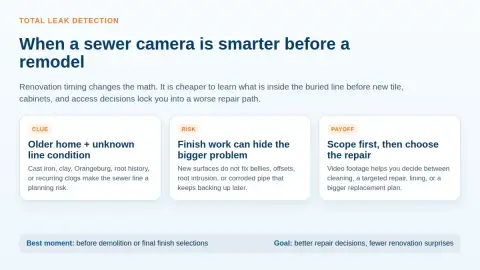
Sewer Camera Before Renovation: What Older Miami Homes Should Check First

If you are thinking about a sewer camera before renovation, the real question is not whether sewer diagnostics sound interesting. It is whether your remodel is about to make a hidden line problem more expensive to deal with later.
That happens more often than homeowners expect. A bathroom or kitchen project starts because the finishes are outdated, the layout needs to work harder, or an older Miami home is finally getting the upgrade it deserves. Then, somewhere in the middle of planning, the drains start acting up. Maybe there is a history of repeated clearing. Maybe the home is older and the sewer material is unknown. Maybe the fixtures work, but not well enough to trust them once new tile, cabinets, or slab-adjacent work is in the plan.
That is where a sewer camera inspection earns its keep. Total Leak Detection's sewer camera inspection service and Florida sewer camera guide both make the same point: older homes, recurring sewer symptoms, and pre-renovation uncertainty are exactly the situations where seeing inside the line changes the next decision.
Here is the short version:
| Renovation situation | What it may mean | Smarter next move |
|---|---|---|
| One fixture is slow, but the rest of the house drains normally | Often still a local fixture or branch-line problem | Start with localized diagnosis before assuming the main line is bad |
| Multiple fixtures are slow, gurgling, or backing up at the same time | The main sewer line deserves suspicion | Scope the line before you commit to finishes or another blind clearing |
| The home is older and no one knows the line material or condition | Hidden cast iron, roots, offsets, or bellies may change the remodel plan | Treat a sewer camera inspection as due diligence, not an afterthought |
| You are considering jetting, rerouting, or adding plumbing load | Cleaning or fixture changes may not solve a structural defect | Use video evidence to decide whether cleaning, repair, lining, or replacement makes sense |
| Sewage is backing up or contamination is spreading | This is no longer a routine remodel-planning question | Pause the project and get urgent professional help |
The goal is not to say every older Miami home needs sewer work before a remodel. It is to explain why some remodels deserve a clearer look at the buried line before the expensive parts of the project move forward.
Why remodel timing changes the value of a camera inspection
The value of a sewer camera inspection is different before a remodel than it is after one. Before the work starts, the inspection gives you leverage. After finishes go in, the same discovery can turn into rework, access headaches, and much uglier budgeting.
TLD's sewer camera service page says camera work is worth scheduling before renovations, for older homes over 20 years old, and whenever recurring sewer symptoms keep pointing back to the main line. The company's sewer guide goes farther by explaining why Florida properties deserve extra caution: root intrusion, sandy-soil shifting, high water tables, aging infrastructure, and cast-iron deterioration all raise the odds that a sewer issue is hidden until the wrong moment.
That is why remodel timing matters so much. If you scope the line before the project is locked in, you can answer questions such as:
- Is the line mostly dealing with buildup that cleaning can address?
- Are there offsets, bellies, or separated joints that make recurring backups more likely?
- Is there corrosion or structural damage that should change the repair sequence before new work covers the access path?
- Is the current access point good enough, or will documenting the distance from the cleanout matter later?
Those are not theoretical questions in older homes. TLD's published guidance around cast iron and sewer-camera planning repeatedly points back to the same risk: homeowners spend money on the visible part of the project while the buried line stays a guess. If the drains have been sending mixed signals already, that is often the wrong order.
The smarter mindset is simple: a sewer camera inspection before renovation is not about chasing problems. It is about lowering the chance that your remodel introduces a second project you did not budget for.
Pipe conditions worth finding before new finishes go in
The biggest reason to scope first is that sewer symptoms do not all point to the same fix. A camera turns a vague risk into a visible condition.
According to TLD's What Can a Sewer Camera Inspection Actually See? article, a proper camera run can reveal roots, grease, offsets, separated joints, bellies, cracks, corrosion, and even collapse. It also usually records distance from the access point, which matters when someone later needs to target a repair instead of opening up the wrong place.

Before a remodel, those findings usually fall into three practical buckets:
Conditions that may still support cleaning
Heavy scale, grease buildup, and some root intrusion can point toward cleaning or jetting if the pipe structure still looks sound. In those cases, the camera helps you avoid overspending on replacement when the better answer may be maintenance plus monitoring.
Conditions that explain why the problem keeps returning
Offsets, separated joints, and bellies are where a lot of homeowners lose money. A line can be "cleared" and still keep misbehaving because the shape or alignment of the pipe keeps catching debris. If the remodel is going forward anyway, this is exactly the kind of issue you would rather understand before fresh finishes and scheduling pressure make a second excavation or access decision more painful.
Conditions that can change the project sequence fast
Cracks, severe corrosion, deformation, or collapse are the findings that can make the remodel plan itself worth revisiting. That does not automatically mean a full system replacement. It means the repair decision should follow documented evidence rather than wishful thinking.
This is where TLD's camera article is especially useful: it is honest about limits. A camera cannot see outside the pipe, cannot measure slope or depth by itself, and may stop at a hard blockage or collapse. But that limitation does not make the inspection less useful. It tells you what was confirmed, how far the run went, and what still needs a more careful plan.
When a home inspection or another drain clearing is not enough
A common remodel mistake is assuming someone already checked the sewer question. Sometimes that "someone" is a prior home inspector. Sometimes it is the last plumber who snaked the line. Neither automatically answers what a remodel team actually needs to know.
InterNACHI's Home Inspection Standards of Practice says inspectors are not required to inspect underground utilities or underground items. That is the gap many homeowners do not realize they are carrying into the project. A general home inspection can be excellent at many things and still not show you what the main sewer line looks like from the inside.
TLD's sewer inspections before buying a home article makes the same point from the buyer side: standard home inspections usually do not include a camera run through the main sewer line, even though hidden defects in the line can become very expensive later. That same blind spot matters in a remodel.
Another weak substitute is repeated clearing without footage. Snaking can be the right next step for some drain problems. But if the line keeps telling the same story - multiple slow drains, gurgling, odors, backups, or problems that come back after temporary relief - the decision has changed. TLD's cast-iron warning-signs article frames this well: once recurring symptoms, age risk, and renovation uncertainty stack together, another hopeful clearing stops being a plan.
That does not mean you panic at every slow sink. It means you ask a better question:
Are we still solving a local clog, or are we spending remodel money while the main-line condition is still a guess?
If the answer is unclear, the sewer camera inspection is often the fastest way to reduce uncertainty before the expensive parts of the project move forward.
Before jetting, moving drains, or adding fixtures
Some of the most expensive sewer mistakes happen when homeowners jump from symptoms straight to a remedy they like.
Hydro jetting is a good example. TLD's camera guidance notes that cleaning methods can make sense when the pipe structure is still healthy, but footage matters because jetting is a different decision from repairing a separated joint, lining a failing section, or planning for replacement. If the line has a belly, offset, or collapse, aggressive cleaning does not solve the structural reason the debris keeps collecting.
The same logic applies when a remodel involves moving drains, reworking bathrooms, or increasing how a space is used. A sewer camera inspection does not replace design, permitting, or code review. But it can tell you whether the existing buried line looks healthy enough to support those decisions without carrying a hidden defect into the finished project.
This is why pre-renovation camera work is strongest in situations like these:
- an older home with unknown sewer history,
- repeated drain or backup complaints from more than one fixture,
- a cast-iron or older-material suspicion that has never been scoped,
- a remodel budget that would be badly disrupted by post-finish excavation,
- or a plan to clean, jet, or rework drains without clear evidence of what the line condition actually is.
TLD's sewer camera guide says a standard residential inspection often takes 30 to 60 minutes when access is straightforward, though older or more complex setups can take longer. That is a small planning window compared with what happens if the buried-line problem only becomes obvious after the cabinets are set, the bathroom is tiled, or the contractor has moved on to the next phase.
What to ask for in the video or report before you approve repairs
The best outcome of a sewer camera visit is not "we got a camera in there." The best outcome is a report or video set that helps everyone price the same problem.
TLD's sewer camera service page says the company provides HD video, a complete recording, and a findings report. That matters because remodel-related sewer decisions can get noisy fast. One person says it probably just needs cleaning. Another thinks it is old cast iron. A third suggests replacement because no one trusts the unknown.

Before you approve sewer-related work during a remodel, ask for these basics:
- Video or clear still captures. Verbal summaries are not enough when repair scope may affect cabinets, slab access, or scheduling.
- The defect type. Is the issue buildup, root intrusion, a belly, an offset, corrosion, cracking, or a harder structural failure?
- Distance from the access point. That measurement matters when someone has to target the repair accurately.
- How far the camera actually reached. If a blockage stopped the run early, that limit should be documented before anyone oversells certainty.
- The recommended next move. The useful choices are usually some version of clean, monitor, spot repair, line, or replace - not vague panic.
If you are collecting more than one bid, share the same footage and report. That is one of the easiest ways to keep contractors pricing the same problem instead of giving you wildly different recommendations built on different assumptions.
When to pause the remodel and treat the sewer issue as urgent
Most pre-renovation sewer questions are about planning, not emergencies. But some conditions should stop the remodel conversation and move straight into urgent cleanup and diagnosis.
EPA guidance on sewage backflow says contamination should be assumed to contain potential pathogens including bacteria, fungi, viruses, and parasites, and that remediation should begin quickly because the health risk rises the longer the contamination persists. In plain English, if wastewater is backing up into occupied areas, you are no longer dealing with a harmless inconvenience.
Treat the sewer issue as same-day urgent if:
- sewage is entering tubs, showers, floor drains, or living areas,
- multiple fixtures are overflowing together,
- contamination is spreading where people or pets are exposed,
- or the line problem is escalating fast enough that continued use will clearly worsen damage.
In those cases:
- Stop sending more water into the system.
- Keep people and pets away from the contaminated area.
- Do not rely on chemical cleaners to fix a backed-up main line.
- Move to professional cleanup and direct sewer-line diagnosis.
For the non-emergency cases, the decision rule is more measured. If the home is older, the line condition is unknown, and the remodel would become more expensive if a buried-line defect is discovered later, that is when a sewer camera inspection is doing exactly what it should do: giving you better information before the wrong work gets locked in.
If your drains have been sending mixed signals and you are about to invest in new finishes, start with a documented sewer camera inspection before authorizing blind sewer repairs or assuming the line is fine. In an older Miami home, that single step often separates a controlled remodel from an avoidable surprise.
This article is for general education only, not engineering, health, legal, or code advice. Pipe material, access, and repair scope vary by property, so confirm the next step with qualified inspection and repair professionals before approving invasive work.