Why Your Toilet Bubbles When Your Washing Machine Drains: Causes and Solutions
Updated November 9, 2026.
A toilet that bubbles while the washing machine drains is showing air moving through the bowl. The washer emptied, and the air in that shared drain had to go somewhere. Sort three places before you treat the toilet: the vent that should carry the air outside, a partial clog in a branch the washer and that bathroom share, and a restriction farther along in the main line or sewer. The checks below use what you can see from the bathroom. They do not open the pipe. When the pattern sits past one bathroom, the next step is a sewer camera.
If you already want the line looked at, book the evaluation and use the sort below to describe what you saw.
What the bubbles are showing
A washing machine empties a tub of water in one push. That water has to move down a drain, and the air already in the pipe has to move too.
A vent is the pipe that gives the air a path. The International Code Council's guide to the 2021 International Plumbing Code, published August 3, 2020, says Section 904.1 requires the vent system for each building drain to have at least one vent pipe that extends to the outdoors. The same guide defines a vent stack as a vertical vent pipe installed to circulate air to and from the drainage system.
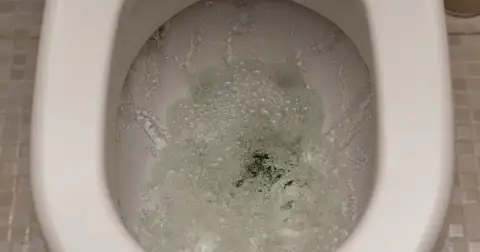
The toilet bowl is a water seal you can see. Bubbles mean air passed through that water. A blocked vent, a narrow branch, and a main-line restriction can all send air out the bowl. Which fixtures react is what separates the three.
Sort the three causes
Vent
What you notice: the toilet flushes when the washer is off. Bubbles or a gurgle show up while the washer, the tub, or the shower empties. Other bathrooms drain as usual. Water does not climb in a tub or a floor drain.
What that pattern fits: water is still getting through the drain, and the air is looking for a way out. The vent is the outdoor path that model plumbing code describes for that air. A cap, a nest, or debris at the opening can close it. Stay off the roof. If you can see the vent from the ground and something is covering the opening, write that down and stop.
Partial clog in a shared branch
What you notice: the washer and one bathroom react together. The tub or shower in that room drains slowly, or the toilet bubbles when the tub empties, and a bathroom at the other end of the house does not. The toilet still flushes once the other fixture is quiet.
What that pattern fits: the washer and that bathroom join the same branch, and the branch has only a narrow opening left. Water still passes, which is why the room is not overflowing. The washer's push is larger than a hand-wash, so the air ahead of it comes up the bowl.
Main line or sewer
What you notice: more than one bathroom is involved. A tub, shower, or floor drain rises while the washer runs. Drains stay slow after the cycle ends. You smell sewage at a fixture, not only at the washer door.
What that pattern fits: the shared point is downstream of a single bathroom, in the building drain or the sewer line leaving the house. Bubbles do not prove a collapse, a root mass, or a broken pipe. They mean the line should be seen.
Home checks
Do these in order. Stop if wastewater shows up in a tub, shower, floor drain, or the toilet.
- Write down which fixture is running when the bubbles start. Washer only, tub only, or both.
- With the washer off, flush the toilet once. A flush that clears, and a bowl that sits still, means the toilet trap is open.
- Run one washer drain and watch the bowl. Note bubbles only, or water that rises and stays high.
- Run the tub or shower in that same bathroom for a minute. If the toilet bubbles then too, the bathroom and the laundry are on the same problem.
- Check one other bathroom. Slow drainage or a gurgle there moves the sort to the main line.
- Look at the washer's drain hose only if it is already in sight. Note a kink, or a hose pushed so far into the standpipe that it fills the opening. Leave the machine where it is.
Skip the plunger when the toilet flushes on its own. The bowl is where the air came out. Leave chemical drain cleaners out of this check. A product poured in the bowl does not show which pipe is tight.
When it is a camera job
Book a camera when any of these are true:
- A second fixture or a second bathroom reacts.
- Water rises in a tub, shower, or floor drain.
- The sewage smell is at a drain.
- The bubbles continue after the checks above.
- You can see a covered vent, and you are staying off the roof.
A sewer camera inspection sends a camera through the line and records what is there. Total Leak Detection's sewer camera page says the visit uses an HD camera on a flexible cable, includes the video recording, and offers same-day appointments when available. That page says most inspections take 30 minutes to an hour, and that the detailed report is provided the same day. Those figures describe the service page. A house with a hard-to-reach cleanout can take longer.
The sewer camera inspection guide explains what the recording can show: roots, a sag, an offset, or a broken pipe. If wastewater is already coming back into the house, that guide says to stop using water, and to skip chemical drain cleaners on a main-line backup because they rarely clear the blockage and can leave a hazardous pool for whoever opens the line.
The camera is how you stop guessing between a vent, a branch, and the main line. Clearing the pipe or repairing it comes after the recording shows what is there.
A running toilet is a different problem
A leak is water leaving the tank or the bowl while no other fixture is running. A fill valve that stays open makes the toilet run. It does not explain bubbles that start when the washer drains. How to identify and fix common toilet leaks covers a running toilet, water at the base, and water that leaves the tank on its own.
Book a $49 leak evaluation
Total Leak Detection serves Miami-Dade, Broward, and Palm Beach Counties. Book a $49 Leak Evaluation with the button below. The contact page lists (855) 385-5325, a 4.6 rating from 145 reviews, and same-day appointments. It says licensed technicians can often diagnose a leak the same day, and it lists the company as licensed and insured.
The sewer camera inspection guide describes Total Leak Detection as family-owned in Florida since 2019.
As of November 9, 2026, the Florida Department of Business and Professional Regulation record for license CFC1430460 lists Alejandro Manuel Diaz, doing business as Total Leak Detection, as a Certified Plumbing Contractor with status Current, Active. That record shows a licensure date of November 19, 2019, and an expiration of August 31, 2028.
This page is general information about a drain symptom. It is not a diagnosis of your line, and it is not insurance or legal advice.
Frequently Asked Questions
- Why does the toilet bubble when the washing machine drains?
- The washer sends a tub of water into a shared drain, and the air already in that pipe has to move. A vent is the outdoor path for that air. When the air leaves through the toilet water, the bowl bubbles. The bowl does not show whether the vent, a shared branch, or the main line is the tight spot.
- How do I tell a vent problem from a clog?
- If the toilet still flushes, other rooms drain normally, and the bubbles show up only while one large fixture empties, the pattern fits a vent that is not moving air. If the tub or shower in that bathroom is also slow, or water rises in another fixture, the pattern fits a restriction in the shared branch or the main line. The home checks on this page sort the call. They do not open the pipe.
- When is a bubbling toilet a sewer camera job?
- Book a camera when a second fixture or a second bathroom reacts, when water rises in a tub, shower, or floor drain, when you smell sewage at a drain, or when the bubbles continue after the home checks. The camera records the inside of the line. Bubbles alone do not prove a collapse, roots, or a broken pipe.
- Can a toilet leak cause bubbles when the washer drains?
- A leak is water leaving the tank or the bowl while no other fixture is running. A fill valve that stays open makes the toilet run. Bubbles that start when the washer drains are a drain and vent question. Use the toilet leak guide for a running toilet or water at the base.
- Should I plunge the toilet or use a drain cleaner?
- Skip the plunger when the toilet flushes on its own. The bowl is where the air came out. Leave chemical drain cleaners out of this check. On a backup, the sewer camera inspection guide says to stop using water and to skip chemical drain cleaners, because they rarely clear the real blockage and can leave a hazardous pool in the line.