Water Meter Test for Hidden Leaks: What Homeowners Can Safely Check First
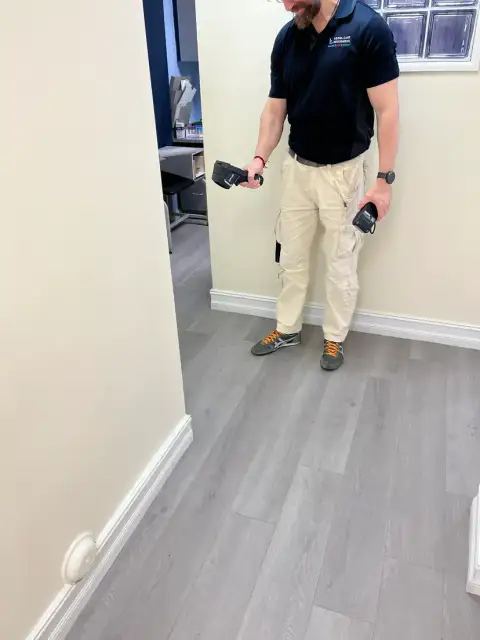
Water Meter Test for Hidden Leaks: What Homeowners Can Safely Check First

If you are trying to run a water meter test for hidden leaks, the smartest first question is not, "Where should I open the wall?" It is, "Is water still moving through the system when nothing should be using it?" That is what the meter test helps answer.
Used correctly, the test can confirm that water is still flowing somewhere on the property. Used carelessly, it can send you in circles because a moving dial does not tell you whether the problem is under the slab, behind a wall, in the irrigation system, or on the line between the meter and the house.
That distinction matters. The EPA says household leaks waste nearly 1 trillion gallons of water each year nationwide, and the average home's leaks can waste more than 9,300 gallons annually. So the meter test is worth doing. But Total Leak Detection's DIY guidance and its leak detection service page both point to the same practical truth: the meter can confirm a problem exists, while professional detection is what turns that proof into a targeted repair location.
Here is the short version:
| Meter-test result | What it suggests | Best next move |
|---|---|---|
| Meter moves with everything off | Water is still flowing somewhere | Narrow the system before assuming the location |
| Meter stops after house shutoff | The stronger suspect is inside the home's plumbing | Check fixtures and interior symptoms first |
| Meter stops only after irrigation shutoff | The irrigation side deserves priority | Check zones, valve boxes, and controller behavior |
| Meter moves after both house and irrigation are isolated | A service line or another outside pressurized line is more likely | Avoid guessing and schedule targeted detection |
When a water meter test is worth doing
The meter test is most useful when you have leak symptoms, but not a visible source.
Total Leak Detection's article on when to call a leak detection specialist lists the familiar warning signs:
- an unexplained water bill spike,
- meter movement when fixtures are off,
- running-water or dripping sounds when nothing is on,
- warm or damp floor spots,
- stains, soft drywall, or bubbling paint,
- musty odors that do not match ordinary humidity,
- or repeated backups that may point to a larger plumbing problem.
That is the sweet spot for the meter test. You have enough evidence to suspect hidden water loss, but not enough certainty to start cutting drywall, breaking slab, or digging the yard.
The test is less useful as a first step when the leak is already visible and accessible. If a shutoff valve is dripping under the sink or a washing machine hose is clearly leaking in the open, repair is usually the first move. It is also not the right priority during active flooding, sewage backup, or water near electrical hazards. In those situations, safety and emergency control come first.
So think of the meter test as a triage tool. It helps answer whether the problem is active enough to keep pursuing and whether the next step should be isolation, fixture checks, irrigation checks, or professional leak detection.
How to run the meter test without false positives
The most common meter-test mistake is not the reading itself. It is bad test conditions.
According to the Portland Water Bureau leak guide, you should start by turning off all water use inside and outside the home. That includes showers, sinks, laundry, dishwashers, and other water-using appliances. If your property has irrigation, make sure it is not scheduled to run during the test window.
EBMUD adds one of the most useful practical tips: take a photo of the dial or line up a pin or toothpick with the meter hand before you wait. That gives you a clean before-and-after comparison instead of relying on memory.

A homeowner-safe workflow looks like this:
- Turn off every intentional water use in the house and yard.
- Wait until the property is genuinely quiet - no laundry cycle ending, no dishwasher filling, no irrigation zone about to start.
- Open the meter carefully and identify either the leak indicator or the sweep hand.
- Take a photo of the meter position.
- Wait about 30 minutes for a basic test window, or longer when you suspect a slower leak.
- Recheck the meter before anything is turned back on.
If the leak indicator spins, or if the sweep hand or reading changes during the quiet window, water is still moving somewhere on the property.
Portland's guide adds another useful detail for slow leaks: if nothing appears to move right away, note the hand position and check again after a longer period with no water use. That is one reason timing matters. A short test can miss a slow leak, while a rushed test can create a false positive because someone flushed a toilet or an appliance cycled in the background.
This is also why the article needs to stay honest. The meter test is not "proof of a slab leak." It is proof that water may still be flowing when you expected the system to be still.
What to shut off before you trust the result
The real value of the meter test starts after the first positive result.
Portland says the next step is to shut off the house's main water valve and then verify that the valve actually works by turning on a faucet inside. If water still flows after several seconds, the shutoff is not doing its job, and your interpretation is already compromised.
Once the house valve is confirmed, return to the meter:
- If the meter is still moving, water is likely flowing somewhere between the meter and the house shutoff.
- If it stops, the stronger suspect is inside the home's plumbing system.
EBMUD adds the irrigation caveat that many homeowners miss: if the irrigation system branches off before the house shutoff, the irrigation valve must be turned off too. Otherwise, you can misread the result and blame the house plumbing for water that is actually being lost outdoors.
That makes the shutoff sequence more valuable than the raw meter reading alone:
- Test the meter with the property quiet.
- Shut off the house main and verify the valve works.
- If irrigation has its own upstream branch, shut that off too.
- Recheck the meter after each isolation step.
This is where homeowners save the most guesswork. A moving meter with no isolation is only a problem. A moving meter after house and irrigation shutoffs starts to become a clue.
What a moving meter proves and what it does not
This is the section most quick articles skip, and it is the one readers usually need most.
Total Leak Detection's DIY leak-detection article says the meter test can show that water is moving, but it cannot tell you where that water is going. The company's broader DIY vs. professional leak detection explainer makes the same point in longer form: you can confirm a leak exists without learning whether it is under the slab, in a wall, at a fixture, or on an outside line.

Here is what a moving meter does prove:
- Water is passing through the meter during the quiet test window.
- The problem is likely active enough to keep investigating.
- A "high bill with no explanation" may not be just a billing fluke.
Here is what it does not prove:
- the exact leak location,
- whether the leak is under the slab,
- whether the source is inside or outside without shutoff testing,
- whether a stain on one side of the house matches the actual leak point,
- or whether demolition is the right next step.
That last point matters. Water travels. A stain can show up several feet from the true leak path. A wet yard can be irrigation, a service line, runoff, or migrating water from another direction. A warm floor can point toward hot-water plumbing, but it still does not tell you exactly where to open.
So the meter test is best treated as a smart filter. It narrows the number of stories you should believe. It does not finish the investigation.
When the result points to irrigation, indoor plumbing, or a service line
Once you use shutoffs correctly, the meter starts giving you better decision-making value.
If the meter stops after the house shutoff is closed, the stronger suspect is inside the home's plumbing. That may mean a toilet, a fixture line, a water heater connection, or another interior source.
If the meter keeps moving until the irrigation side is shut off, the outdoor system deserves priority. That does not automatically mean one broken head is the whole story, but it does mean the irrigation side has earned the next inspection.
If the meter keeps moving even after both the house and irrigation are isolated, Portland and EBMUD both point toward the line between the meter and the house shutoff or another outside pressurized line as the stronger suspect.
That is the moment to stop treating the problem like a generic "hidden leak somewhere." The pattern is now narrower.
Use this quick interpretation table:
| Isolation result | Stronger suspect | Better next question |
|---|---|---|
| Stops after house shutoff | Indoor plumbing | Which fixture or plumbing zone still fits the symptoms? |
| Stops only after irrigation shutoff | Irrigation system | Which zone, valve box, or controller setting matches the loss? |
| Keeps moving after both are off | Service line or another outside pressurized line | Where can targeted detection confirm the exact buried location? |
| Does not move, but symptoms keep returning | Intermittent leak, past leak, condensation, or non-plumbing issue | What condition triggers the symptom, and what should be tested next? |
If your main confusion is specifically outdoor versus under-slab plumbing, Total Leak Detection's slab leak vs. irrigation guide is the better next read. The meter test belongs inside that bigger logic, not outside it.
When to stop testing and call professional leak detection
A good homeowner test should reduce bad decisions. It should not create new ones.
Stop the DIY phase and schedule help when:
- the meter proves water loss but the source is still unclear,
- the result changes after shutoff testing but you still do not know where to open or dig,
- warm floors, recurring stains, musty odors, or hidden moisture keep coming back,
- water is near electrical components,
- or your next idea is to cut drywall, tile, flooring, or landscaping just to "see if that is it."
This is where Total Leak Detection's trial-and-error article becomes useful. Its point is simple: locate first, repair second. The value of professional leak detection is not only finding a leak. It is avoiding multiple wrong openings before the repair even begins.

According to TLD's service page, the professional process typically includes symptom review, water-meter and fixture checks, and non-invasive tools such as thermal imaging, acoustic detection, and moisture meters. The goal is a clearer location, a better repair handoff, and less property damage from guesswork.
That is the right handoff point:
- the meter told you a leak likely exists,
- the shutoffs narrowed the system,
- but the location still needs real source finding.
At that point, another hour of homeowner guessing is usually less valuable than one focused diagnostic visit.
What to document before you schedule service
If you want the meter test to save time instead of just adding stress, keep a simple record.
Before you schedule service, save:
- a photo of the meter at the start of the test,
- a second photo at the end of the quiet window,
- a note on whether the house shutoff changed the result,
- a note on whether the irrigation shutoff changed the result,
- one or two bill screenshots if a usage spike started the investigation,
- photos of any stains, wet areas, warm floor spots, or yard clues,
- and a short note on when the symptom shows up: all the time, after irrigation, after hot-water use, or only intermittently.
That gives the technician a better starting point than "the bill seemed high" or "we heard something last week."
If you are already at that stage, skip blind demolition and start with a targeted leak detection visit or use Total Leak Detection's contact page to request service.
The water meter test is worth doing because it gives homeowners a clean first check. The mistake is expecting it to do the whole job. Its real purpose is to confirm that water is still moving, narrow the system with shutoffs, and tell you when the next move should be professional source finding instead of a more expensive guess.
This article is for general education only, not engineering, utility-billing, or legal advice. Shutoff layouts, irrigation branches, and plumbing paths vary by property, so confirm the source with a qualified professional before authorizing invasive repairs.