Back for the Season? A Leak Check Before You Turn the Water Back On
Published October 30, 2026.
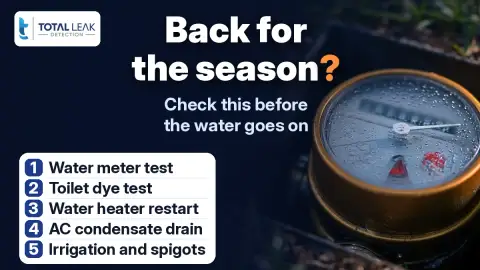
A seasonal home leak check is a walk-through plus a few tests before a closed-up house goes back to daily use. Snowbirds do it on the day they return to South Florida, before showers, laundry, and the irrigation timer start again.
A house that sat empty is different from a house someone used every day. A slow drip can run while nobody is there to see it. How long a hidden water leak can go undetected covers that problem. This page is the return-day list: look first, then the meter, the toilets, the water heater, the air conditioner, and the yard.
Look before you turn the water back on
Leave the main water off and walk the house before you open it.
Look at ceilings, under sinks, the floor around the water heater, the indoor air conditioner and its drain pan, and the floors you walk across. Note a musty smell while the house is still closed up. Write down the room. A smell without a wet spot is still a note worth keeping.
As of October 30, 2026, the EPA WaterSense leak checklist says to check beneath the water heater for standing water and rust.
Photograph what you see before you wipe, dry, or move anything. As of October 30, 2026, the Florida Department of Financial Services Homeowner Claims Bill of Rights guide says to take photos and video before repairs, and again after. The same guide says to keep damaged items where that is feasible, and to keep receipts.
Step 1: Run a water meter test
On a Miami-Dade Water and Sewer account, the meter is usually in the front yard, near the street or the sidewalk. As of October 30, 2026, Miami-Dade WASD says a flow indicator that moves when nobody is using water can mean a leak.
That page describes a register test. Turn every water use off, inside and outside. Read the meter. Wait two hours without using water. Read it again. The WASD leak-detection guide uses that same two-hour wait. EPA WaterSense Fix a Leak Week also says to read the meter before and after a two-hour period with no water use.
If the register moved, close the house valve and repeat the test. WASD says a meter that still moves points to the service line or an outside device. A meter that stops points inside the house.
WASD maintains the line up to and including the meter box. Past the meter box, the account holder is responsible. WASD lists Customer Relations at 305-665-7477 for questions about the utility side of that line.
The full homeowner method for reading a meter is on water meter test for hidden leaks. The Miami-Dade check on this page is the two-hour register test and the house-valve repeat above.

Close the house valve and read the meter again. Miami-Dade WASD says movement that continues points to the service line or an outside device. Movement that stops points inside the house.
Step 2: Dye-test every toilet
Miami-Dade WASD says toilet leaks are the most common leaks. The WASD leak-detection page and the WASD guide both say to put dye or food coloring in the tank and look at the bowl after 20 minutes. Color in the bowl means water is leaving the tank.
EPA WaterSense says to check the bowl after 10 minutes. A 20-minute wait covers the WASD instruction and the EPA one. Flush afterward so the color does not stay in the bowl.
The WASD guide says free dye tablets are available at WASD customer service centers. The same guide says to consult a plumber for a running toilet, a water heater that drips, or a supply line. Those are repair items. A leak-detection visit is the separate question of where hidden water has already traveled.
EPA WaterSense says to replace toilet flappers at least every five years. That interval is on the Fix a Leak Week page. Follow the flapper instructions that come with the part you buy.
Step 3: Bring the water heater back carefully
Read the manual for the heater that is actually in the house. As of October 30, 2026, A.O. Smith says the manual takes precedence over a general article.
If the heater sat in vacation mode and the tank stayed full, set it back to normal use. The Whirlpool water heater manual (317252-002) describes Vacation Mode for an extended absence and says to set the control back when you return.
If the power or the water was shut off, or the tank was drained, fill the tank completely before power comes back. Open a hot faucet and let the air clear until water runs steadily. A.O. Smith says to do that fill-and-purge step before power or gas. The Whirlpool manual says not to power the heater on unless the tank is completely filled. A.O. Smith says an electric heating element can burn out if the tank is empty when power returns.
If you smell gas at a gas heater, stop and call your gas utility. A.O. Smith says not to proceed if you smell gas.
GE Appliances describes a seasonal or second home this way: turn off power and water while you are away. GE says draining the heater guards against unexpected leaks and hydrogen gas buildup, and says to see the owner's manual. Use that manual for any drain or restart steps on a GE unit.
When the tank is back in service, look underneath it. The EPA WaterSense checklist says to check for standing water and rust.
Step 4: Run the AC and watch the condensate drain
Turn the air conditioner on and watch the indoor unit and the drain pan. As of October 30, 2026, the ENERGY STAR maintenance checklist says a plugged condensate drain can cause water damage and can affect indoor humidity.
Trane lists signs of a clogged drain line: puddles near the indoor unit, rust on the bottom of the unit, a musty smell, and a unit that is not cooling or not turning on. Trane also notes that some systems have a float switch that can shut the unit off.
Clearing the drain line is work for an HVAC company. Where that water already went, across a pan, a closet floor, or a ceiling, is a leak and moisture question. Photograph the wet spot before anyone dries it.
Step 5: Check irrigation and outdoor spigots
Walk the yard with the sprinklers off, then again while a zone runs if you are ready to watch it. The EPA WaterSense checklist says to look for broken sprinklers and nozzles pointed the wrong way, and to check the hose washer at an outdoor spigot.
The house-valve test in Step 1 is what separates inside use from outside use. A meter that stops after the house valve is closed was moving because of something inside. A meter that keeps moving was not stopped by that valve, so WASD's reading points to the service line or an outside device.
What each finding suggests
| Finding | What it suggests | Next step |
|---|---|---|
| Meter moves, use off | Water still moving | Close house valve, retest |
| Stops after house valve | Movement was inside | Check toilets and heater |
| Color in the bowl | Tank water reached bowl | Note it, then flush |
| Water or rust at heater | Moisture under the tank | Photo before cleanup |
| Water at the AC pan | Condensate not draining | HVAC clears the line |
| Stain or soft drywall | Water already traveled | Photo; leave wall closed |
| Warm floor or running sound | Water may be unseen | Stop and call |
Stop-and-call signs
Stop the home checks and call for detection when any of these are true:
- The meter still moves after the house valve is closed.
- A spot on the floor feels warm.
- You hear running water with every fixture off.
- A stain grows after you first see it.
- A musty odor is still there after the house has been aired out.
Leave walls and floors closed. Opening them to look removes the clues and adds a repair before anyone has documented the source. What happens during a professional leak detection visit describes how that visit narrows the system and writes down what it shows.
Photos and notes to keep for a claim
The Florida Department of Financial Services guide What to expect after filing a homeowners claim says to report the claim immediately, to take photos before and after repairs, and to list damaged items. The same guide says to follow up if an adjuster has not contacted you within one week.
The Homeowner Claims Bill of Rights guide says to make and document emergency repairs that prevent further damage, to keep receipts, and to keep damaged property where that is feasible. It says to contact your insurer before you sign a repair contract. It also says to verify a contractor's license at MyFloridaLicense.com.
Ask your agent how your policy treats a home that was unoccupied.
If the water showed up on a condo ceiling, the Florida condo ceiling leak checklist is the list of what to record before repairs start.
Book a $49 leak evaluation
Total Leak Detection is family-owned since 2019. We serve Miami-Dade, Broward, and Palm Beach. Leak detection on a return visit means looking for the source and documenting what the inspection shows.
This page is general information, not insurance or legal advice.
Frequently Asked Questions
- How do I check a closed-up home for leaks?
- Walk the house with the water still off and photograph anything wet or stained before you touch it. Then use the checks on this page: a water meter test, a toilet dye test, a careful water heater restart, the air conditioner condensate drain, and irrigation and outdoor spigots. Miami-Dade WASD describes the meter test and the toilet dye test, and the EPA WaterSense checklist covers the base of the water heater, sprinklers, and the hose washer.
- How long should I watch the water meter?
- Miami-Dade WASD says to turn all water off, record the meter, and check it again after two hours. EPA WaterSense uses that same two-hour period with no water use. If the reading changed, WASD says to close the house valve and repeat the test.
- How long does a toilet dye test take?
- EPA WaterSense says to check the bowl 10 minutes after dye goes in the tank. Miami-Dade WASD says to check after 20 minutes. Color in the bowl means water left the tank. Flush when you finish.
- Should I turn the water heater on before the water?
- No. Fill the tank first. A.O. Smith says to fill the tank and run a hot faucet to purge air before power or gas is restored, and says an electric element can burn out if the tank is empty. The Whirlpool water heater manual says not to power the heater on unless the tank is completely filled. If the heater only sat in vacation mode and stayed full, that manual says to set it back to normal.