Ceiling Stain: Old Leak or Active Leak? What to Check First
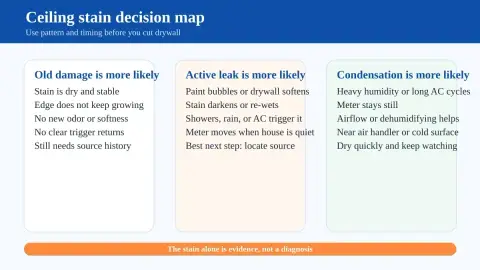
If you are trying to answer the common ceiling stain old leak or active leak question, the stain itself is only the start of the story. A brown ring, soft patch, or damp spot overhead can come from a plumbing leak, a drain or shower problem that only shows up sometimes, an air-conditioning condensation issue, or a past event that dried on the surface but never gave you a clear answer.
That uncertainty is what makes ceiling stains expensive. Homeowners often paint over the mark because it looks dry, or they jump straight to opening drywall because the stain looks dramatic. Both moves can be premature. Total Leak Detection's article on whether a water leak can dry on its own makes the key point clearly: a dry surface does not prove the source is gone. It only proves the visible moisture is not showing right now.
The better question is not "Does this stain look bad?" It is "What pattern does this stain follow?" Once you look at trigger timing, drywall condition, humidity clues, and whether water is still moving somewhere in the system, the next step usually gets much clearer.

What the stain alone can and cannot tell you
A ceiling stain tells you one thing with confidence: water was there. It does not tell you, by itself, whether the problem is over.
That distinction matters because the same stain can come from very different causes:
- a supply leak that is still active,
- a drain or shower leak that only appears during use,
- an air-handler or HVAC condensation issue,
- roof or window moisture after weather,
- or a past leak that dried but left cosmetic damage behind.
This is why a stain that "looks old" can still mislead you. Drywall color, a rust ring, or a faded patch may reflect earlier wetting, but surface appearance does not confirm whether the leak path was repaired. TLD's inactive-leak guidance says technicians often need to review stain patterns, moisture conditions, and trigger timing because old-looking damage can still belong to an intermittent or recently reactivated source.
A few first-glance clues can help, but none of them should be treated as final proof:
| What you notice | What it may suggest | What it cannot prove yet |
|---|---|---|
| A sharp brown ring with no fresh dampness | Possibly older or dried damage | That the source was actually repaired |
| Bubbling paint, softness, or expanding edges | Recent or repeated wetting | Which system is causing it |
| Stain directly below a bathroom, laundry, or air handler | A useful location clue | Whether the issue is supply, drain, condensation, or another moisture path |
| A stain that appears after storms or AC use but not after plumbing use | Weather or HVAC moisture becomes more plausible | That plumbing can be ruled out entirely |
If you live in a condo or multi-family building, ceiling clues can be even trickier because water may travel before it becomes visible. TLD's Florida condo ceiling leak checklist is the better companion article when shared lines, upstairs units, or management access are part of the problem.
Clues it is more likely an active leak
An active leak usually refuses to stay cosmetic. It changes the materials, comes back after the same trigger, or creates another clue somewhere else in the house.
TLD's article on when to call a leak detection specialist lists the strongest warning signs: new stains, bubbling paint, soft drywall, musty odors, meter movement when fixtures are off, and water sounds that do not match normal use. In a ceiling-stain situation, those clues matter because they suggest the system may still be feeding moisture instead of merely showing historic damage.
You should lean toward "active leak" when you see one or more of these patterns:
- The stain grows or darkens. Marking the edge with painter's tape helps you see whether the boundary changes over the next day or two.
- The drywall feels soft, swollen, or blistered. That points to recent or repeated wetting, not just a cosmetic leftover mark.
- The stain returns after a trigger. Showers, laundry, AC run time, rain, or hot-water use can all narrow the likely source.
- A musty odor keeps coming back. Persistent odor often means materials stayed damp longer than the surface appearance suggests.
- The water meter moves when the house should be quiet. That makes a supply-side leak more believable than pure condensation.
The meter clue is especially useful because condensation does not usually send billed water through your plumbing system. If the stain is back and the meter is also moving when fixtures are off, the ceiling problem deserves more urgency.
One more reality check helps here: active does not always mean constant. TLD's inactive-leak page points out that many hard-to-find leaks only happen under certain conditions. A drain line may only wet the ceiling when the upstairs shower runs. A supply line may quiet down overnight or after someone shuts off a fixture valve. A small leak may soak hidden materials first, then appear on the ceiling hours later. Intermittent still counts as active if the same damaged spot keeps re-wetting.

When condensation or HVAC moisture is the stronger suspect
Not every ceiling stain starts with a broken pipe. In South Florida especially, humidity and cooling equipment can create real moisture problems that look plumbing-related at first glance.
The U.S. Environmental Protection Agency says indoor humidity should stay below 60 percent and ideally between 30 and 50 percent when possible. EPA also notes that condensation on building surfaces can be a sign of high humidity and should be dried promptly while the moisture source is reduced. That matters because a stain below an air handler, near a vent path, or in a room with weak airflow may be tied to condensation rather than a pressurized plumbing leak.
Condensation or HVAC moisture becomes a stronger suspect when the pattern looks like this:
- the stain appears mostly during muggy weather or long cooling cycles,
- the area improves when airflow or dehumidification improves,
- the water meter stays still during a quiet test,
- the ceiling problem sits below an air handler, condensate line route, or chronically cold surface,
- and there is no clear plumbing-use trigger such as a shower, laundry run, or toilet refill cycle.
That does not mean condensation is harmless. TLD's pipe sweat versus hidden leak guide makes an honest point that applies here too: humidity-driven moisture can still feed corrosion, stain finishes, and create mold conditions if materials stay wet. The difference is that the solution may lean more toward drainage, insulation, ventilation, or condensate maintenance than toward opening a plumbing wall at random.
This is also why a ceiling stain under an air handler deserves a little humility before demolition. A homeowner may see discoloration overhead and assume the bathroom above is leaking. But if the stain tracks with heavy AC use, sits near a condensate path, and comes with no meter movement, the smarter next move may be documenting the pattern and checking the cooling-side moisture route first.
The practical rule is simple:
- condensation clues only, no material change, no meter movement: improve moisture control and monitor,
- mixed clues or repeat staining: keep documenting and move toward professional source confirmation,
- clear re-wetting, softness, odor, or meter movement: treat it as an active leak until proven otherwise.
How to track triggers before you open the ceiling
Homeowners do not need a perfect diagnosis before calling for help. But a short record of the stain's behavior can make the visit much more efficient.
TLD's hidden leak detection process article recommends documenting stains, writing down what was happening before the moisture appeared, and avoiding the mistake of over-cleaning away the evidence first. That advice matters here because ceiling stains often belong to systems that only reveal themselves when the right trigger is present.
Before anyone opens drywall, save these details:
- Wide and close photos. Take one room-wide photo, one of the ceiling area, and one close enough to show bubbling paint, cracks, or texture changes.
- A marked edge. Painter's tape or a pencil mark helps you see whether the stain is spreading.
- Trigger notes. Record whether the stain changed after rain, a shower, laundry, dishwasher use, hot-water use, or heavy AC runtime.
- Meter result. If safe, turn off fixtures and appliances, wait through a quiet window, and note whether the meter moved.
- Condition notes. Write down whether the drywall feels soft, whether odor is stronger at a certain time, and whether the stain is below a bathroom or air handler.

This kind of tracking does two useful things. First, it lowers the odds of opening the wrong area. Second, it helps the technician decide whether the inspection should focus on supply testing, fixture testing, moisture mapping, HVAC-adjacent condensation, or a broader hidden-leak workflow.
If you are in a condo, add one more column to the record: who was notified and when. Shared systems, upstairs occupancy, and management access can matter just as much as the stain itself.
When a dried stain still deserves leak detection
A ceiling stain can look dry and still justify a professional inspection. That is one of the most important points homeowners miss.
TLD's inactive-leak article explains why: leak detection is easiest when water is actively flowing, but technicians can still learn a lot from residual moisture, damage patterns, photos from the active phase, and careful retesting of the likely line or fixture. In other words, "not dripping today" is not the same thing as "no useful inspection possible."
A dried stain still deserves leak detection when:
- the same spot has come back before,
- the trigger seems tied to a specific fixture or time window,
- the meter moved during a quiet test even though the ceiling looked dry,
- drywall damage or odor kept getting worse,
- or the property needs a clearer handoff before a plumber or contractor opens finishes.
This is where source-finding becomes more valuable than guesswork. TLD's service hub says the goal of a professional visit is a targeted assessment, non-invasive testing, and a report or mark-out that points repairs in the right direction. That can include moisture mapping, acoustic listening, thermal scanning, or running fixtures in a deliberate sequence so the right condition shows itself.
The safer decision rule is this: if the source is visible and accessible, repair can often start with a plumber. If the ceiling stain is the only clue and the source is still hidden, detection first usually saves money, drywall, and time.
When to treat it as urgent
Some ceiling stains can wait a day or two for careful documentation. Others should not wait at all.
Treat the situation as urgent if:
- the ceiling is sagging,
- active dripping or spreading water is underway,
- water is near lights, outlets, or electrical equipment,
- the stain is expanding quickly,
- sewage or drain backup may be involved,
- or the area keeps re-wetting fast enough that damage is accelerating.
TLD's emergency guidance is straightforward on this point: active flooding and water near electrical hazards come before careful DIY observation. Shut off the affected fixture or the main water supply if you can do so safely. Then move to emergency help and source diagnosis.
For non-flooding but suspicious cases, speed still matters. EPA guidance says wet or damp areas should usually be dried within 24 to 48 hours to reduce mold risk. If the stain keeps returning, that drying window keeps resetting. That is why a "small" ceiling stain can become an expensive repair path when the same hidden source is allowed to cycle for another week.
If your ceiling stain is changing, returning, or pointing to a hidden source you cannot see, schedule a professional leak-detection visit before authorizing blind demolition. Total Leak Detection can help narrow the source and provide a clearer repair handoff through its leak detection service. If you are ready to start that process now, request service directly through the company site.
This article is for general information only, not repair, insurance, or engineering advice. Ceiling stains can come from more than one moisture source, so confirm the cause with qualified professionals before opening finishes or authorizing major repairs.